Leadership training for high-performing teams
Build Teams That Think Clearly, Speak Up, and Perform Under Pressure
Beyond Traditional Leadership Training: We are Human Safety Experts Teaching the Mechanics of High Performance.
Unsafe people struggle to collaborate. Unsafe teams lose speed and creativity. Unsafe cultures stall under pressure.
Effective leadership must begin with safety.
Our work comes from environments where safety is not theoretical. We have worked in gender-based violence response, self-defence, and anti-bullying intervention, where shutdown, fear, silence, coercion, and escalation have immediate, real-world consequences.
In those environments, you learn to read threat patterns before they explode. You see how fear drives withdrawal, how people-pleasing becomes a survival strategy, and how silence replaces honest disagreement.
We apply these same high-stakes principles to the corporate world. Whether it’s a physical threat or a high-pressure deadline, the human nervous system responds the same way. We teach your leaders to manage that biological response so they can maintain clarity, trust, and performance when it matters most.
These patterns show up in every organisation—in boardrooms, performance discussions, and whenever decisions carry risk. Most leadership training focuses on surface-level skills. We work at the level that determines whether those skills actually get used when the pressure is real.
We teach the mechanics of safety. We show leaders how their behaviour under pressure either stabilises or destabilises a team.
Safety is the foundation of performance. Leadership sets the conditions.
Our Training Programs for High-Performing Teams
Human Mechanics of Psychological Safety
(90-Minute Team Workshop)
This workshop gives your entire team practical tools to build trust, communication, and collaboration. It establishes the baseline safety conditions that make effective leadership possible.
- Audience: All staff
- Delivery: On-site (SA) or online
- Outcomes: Understanding how fear and pressure affect behaviour, recognising habits that erode trust, learning listening practices that reduce friction, building trust through daily actions, and applying practical feedback techniques teams can use immediately.
Leading High-Performing Teams
(8-Hour Leadership Intensive)
This program equips leaders with diagnostic tools to recognise where physiological, emotional, or psychological safety is breaking down and restore the conditions required for clear thinking and performance under pressure.
- Audience: Executives, Leaders, Managers, HR
- Delivery: On-site (2 days) or online (4×2hr)
- Outcomes: Reading behaviour accurately under pressure, diagnosing system-level issues instead of blaming individuals, interrupting conflict before escalation, restoring accountability at peer level, and maintaining consistent performance when pressure increases.
Human Mechanics of Psychological Safety (90-Minute Team Workshop)
This workshop gives your entire team practical tools to improve trust, communication, and collaboration. It builds the baseline conditions leaders rely on for effective decision-making and accountability.
Participants learn what psychological safety is, how to recognise behaviours that undermine it, and what they can do day-to-day to support clearer communication and shared responsibility.
This session works as a standalone intervention or as the foundation for deeper leadership development.
Audience: All staff
Delivery: On-site (South Africa) or online
Duration: 90 minutes
What your team will learn:
- What psychological safety is and why it underpins high-performing teams
- How fear and pressure change behaviour at work
- Everyday habits that erode trust and engagement
- Listening practices that improve understanding and reduce friction
- Simple daily actions that build trust
- A practical framework for giving and receiving feedback
- How to handle disagreement without escalation
Outcomes: Teams leave with immediately usable tools they can apply in their very next meeting. The impact begins the same day.
Leading High-Performing Teams (8-Hour Leadership Intensive)
This program equips leaders with diagnostic tools to recognise when physiological, emotional, or psychological safety is breaking down, and what to adjust to restore clear thinking and stable performance under pressure.
Built on The High-Performance Leadership Triad™, this program goes beyond psychological safety to address how threat responses, boundaries and communication conditions affect behaviour at all three levels.
By the end of this program, leaders know how to create environments where people feel safe enough to perform at their highest level, even under pressure or during change and uncertainty.
Audience: Executives, leaders, managers, team leads, HR
Delivery: On-site (2 days) or online (4 × 2-hour sessions)
What leaders gain:
- Read behaviour accurately under pressure and recognise threat responses rather than mislabelling people
- Diagnose system patterns instead of focusing on individual “problem behaviour”
- Address tension early before it escalates into conflict or formal issues
- Improve how team members communicate, challenge, and resolve issues with each other
- Restore accountability at peer level instead of carrying unresolved issues upward
- Maintain performance during periods of pressure, change, or uncertainty
Includes: Pre- and post-program assessments with reports showing measurable change.
Optional add-on: 6-month Leadership Risk & Performance Retainer for implementation and support.
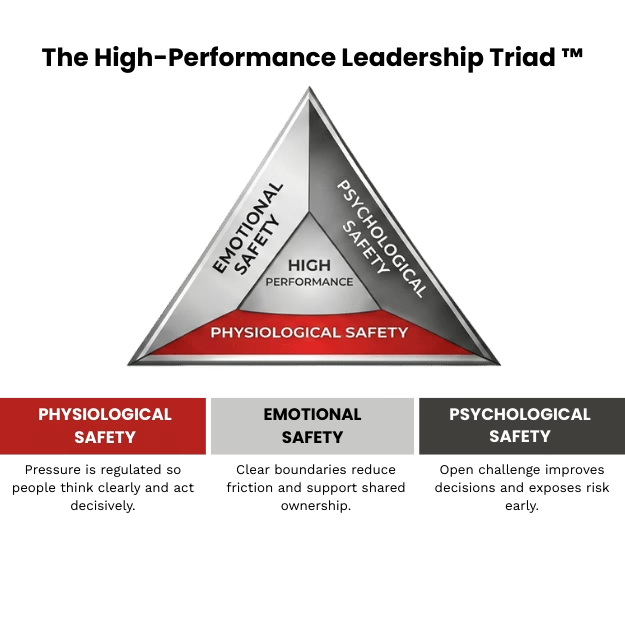
The High-Performance Leadership Triad™
Most leadership training teaches skills. We teach leaders how to read what’s actually happening so they know which skills to use, when, and why.
The Triad is a diagnostic framework leaders can use in real time. When a team’s performance drops under pressure, leaders need to know what’s driving it.
It’s built on three layers that interact constantly:
Physiological Safety (How the Nervous System Responds to Pressure)
When people perceive threat, their nervous system takes over. You see fight (defensiveness, aggression), flight (withdrawal, absenteeism), freeze (silence, paralysis), or fawn (people-pleasing, over-compliance). These aren’t personality issues, they’re survival responses.
Business Impact: When leaders can’t read these patterns, they misread silence as agreement, withdrawal as disengagement, and compliance as commitment. Decisions get made with incomplete information.
Emotional Safety (Trust, Boundaries, and Predictability)
Trust gets built or broken through predictability and boundaries. When expectations are unclear or leaders are inconsistent, people default to self-protection. They hoard information, avoid conflict and manage up instead of solving problems.
Business Impact: Teams waste time managing uncertainty instead of executing. Collaboration breaks down. Work slows.
Psychological Safety (Whether People Speak Up or Stay Silent)
This determines whether people speak up or stay silent. It’s about whether challenging a decision, admitting a mistake, or raising a concern will get someone punished, ignored, or humiliated. One bad response from a leader can shut down a whole team.
Business Impact: Problems that could have been caught early become expensive failures. Innovation dies because risky ideas never get voiced. Diverse perspectives (the ones that drive 2-3x higher innovation rates) get silenced.
When leaders can diagnose which layer is breaking down, they can intervene precisely instead of guessing.
The Leadership Intensive at a Glance
What it is:
A safety-based leadership intensive focused on restoring the conditions required for clear thinking, shared ownership, and performance under pressure.
Why it matters:
Faster problem-solving, clearer decision-making, fewer HR escalations, stronger retention and consistent team performance even during periods of change and uncertainty.
Who it’s for:
Executives, managers, team leads and HR leaders
Formats:
8-hour Leadership Intensive | Virtual (4 x 2-hour sessions) or on-site in South Africa.
Why Safety Comes First
When people don’t feel safe, their nervous system prioritises protection over performance. That’s when organisations see silence in meetings, conflict avoidance, territorial decision-making, information hoarding, and talent disengaging or leaving
Trying to correct these behaviours directly rarely works. The behaviour is an indicator, not the cause.
Most leadership programs teach communication, emotional intelligence, and conflict handling. We focus on the conditions that allow those skills to function under pressure.
When fear is regulated and boundaries are clear, collaboration becomes easier, accountability sits where it should, and high-performance becomes consistent.
The Cost of Low Safety
Most organisations are already paying for low safety, often without realising it.
You see it in meetings where concerns are raised too late. In decisions that go unchallenged until they fail. In strong performers citing “culture” when they leave. In leaders carrying issues their teams should be able to resolve.
Over time, the pattern compounds. People stop speaking up. Teams avoid tension instead of addressing it. Projects slow down. Rework increases. Staff turnover costs multiply. Leadership capacity gets consumed by issues that should never reach that level.
Skills training alone does not change this. People do not use skills they feel unsafe deploying.
You need to change the conditions that make it unsafe to use those skills in the first place.
Some of our Featured Clients













Frequently Asked Questions
What is the Leadership Intensive designed to do?
It helps leaders create environments where people feel safe enough to perform at their highest level, even under pressure. We teach the mechanics of safety, not the theory of leadership.
Who is the Leadership Intensive for?
Executives, managers, team leaders, HR professionals and organisations wanting to improve performance, communication and culture.
What’s the difference between the Foundations workshop and the Leadership Intensive?
The Foundations workshop is designed for the whole organisation. It builds a shared understanding of psychological safety, how fear and pressure affect behaviour, and what everyone can do day-to-day to reduce silence, defensiveness, and avoidance. It creates a common language and baseline conditions that make safer communication possible across teams.
The Leadership Intensive is designed specifically for leaders. It goes deeper and is diagnostic in nature. Leaders learn how to read behaviour under pressure, identify which layer of safety is breaking down (physical, emotional, or psychological), and adjust the conditions that are shaping team behaviour in real time.
In short, Foundations stabilises the environment.
The Leadership Intensive equips leaders to maintain and strengthen it under pressure.
Many organisations start with Foundations to align the wider team, then move into the Leadership Intensive to embed the work at leadership level.
Is the training available online?
Yes. You can book virtual sessions or on-site workshops anywhere in South Africa.
What makes this different from other leadership training?
We provide a specialised form of leadership development. We are human safety experts who teach the mechanics of leadership, focusing on how the nervous system allows skills to be used under pressure.
How long are the programs?
The Foundations workshop is 90 minutes. The Leadership Intensive is 8 hours (2 days in-person or 4 × 2-hour online sessions).
What if we need ongoing support after the training?
We offer an optional 6-month Leadership Risk & Performance Retainer that includes monthly check-ins, team observations, and targeted coaching to ensure lasting change.
Does this training address diversity, equity, and inclusion?
Yes. The framework helps leaders identify when safety breakdowns disproportionately affect underrepresented groups and create conditions where diverse teams actually perform. This integrates equity into core leadership practice.
Employees don’t leave companies, they leave toxic cultures. Create an environment where people feel safe, and they’ll show up, speak up, and stay.
How to Build Psychological Safety at Work (7 Practical Starting Points)
Our training is designed to help teams perform under pressure, and part of it is grounded in what researchers call psychological safety. If you’ve come across the term and want to know what it looks like in day-to-day work, these are practical behaviours you can start with.
These are not “soft skills.” They are actions that reduce fear, surface information earlier, and make it safer for people to engage when it matters.
1. Set the tone
Make it clear that honesty is expected, not punished. People watch closely for how leaders respond when things are uncomfortable.
2. Admit when you don’t know
When leaders acknowledge uncertainty or mistakes, it reduces fear and gives others permission to speak honestly instead of protecting themselves.
3. Invite contribution deliberately
Don’t rely on confidence or seniority to shape discussions. Create space for quieter voices so information doesn’t get filtered out.
4. Listen actively
Pay attention, reflect back what you’ve heard, and close the loop. People speak up more when they know they’ve actually been heard.
5. Normalise learning from mistakes
Address errors early, extract the lesson, and move on. Silence grows when mistakes are treated as personal failure instead of operational feedback.
6. Keep feedback regular and specific
Short, consistent check-ins prevent small tensions from turning into avoidance, resentment, or escalation.
7. Acknowledge speaking up
When someone raises a concern or challenges a decision constructively, recognise it. This demonstrates that safety is real, not theoretical.
These behaviours help reduce fear and hesitation, but they only work consistently when leaders understand what pressure does to people and how safety breaks down in real time.
That’s where our training goes deeper.
What Is Psychological Safety?
Psychological safety is commonly defined as the belief that people won’t be punished or humiliated for speaking up with ideas, questions, or mistakes. Research by Amy Edmondson and Google’s Project Aristotle shows it is a strong driver of team effectiveness.
At FLAG Academy, we use this research as a starting point. Our focus is on how psychological safety interacts with physical and emotional safety when pressure is high — and how leaders can recognise and adjust those conditions in real situations
Why Psychological Safety Matters
When psychological safety is present, teams share information earlier, make better decisions, and recover faster from mistakes. Retention improves. Learning accelerates. Innovation increases.
When it’s absent, people protect themselves. They say less. They avoid conflict. Issues stay hidden until they become expensive.
Our programs don’t stop at explaining psychological safety. We show leaders and teams how to apply it in practice, under pressure, to reduce risk and support consistent performance.